

Roots & Remembrance
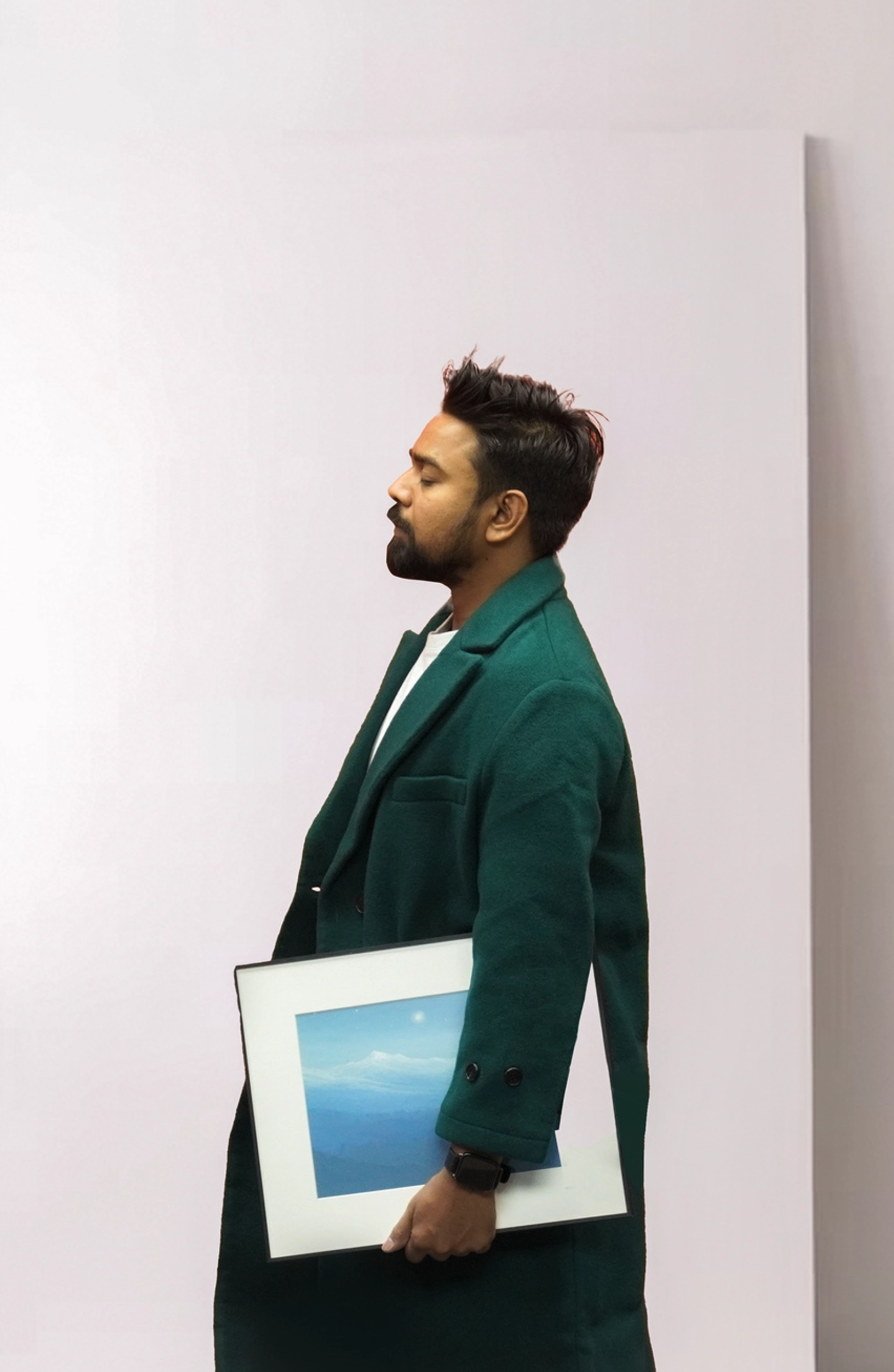
In the House of the Divine: My Artistic Journey Through the Himalayas
My artistic journey has traversed the mighty ranges of the Himalayas, reaching a path where it ceases to be merely a journey and transforms into a living philosophy—a philosophy vibrant, self-aware, and existing beyond imagination. Each step feels like a golden opportunity, inviting me deeper into their silence and mystery. Standing before the vastness of these ranges, one senses the presence of divinity itself: a house where gods silently watch, and every prayer is received without utterance.

The trails I walked were steeped in wonder—towering peaks on one side, deep gorges on the other. Such landscapes stir countless emotions: fear, hope, courage, solitude, prayer, and belonging. They remind us that some paths we choose, while others choose us. In these spaces, time feels suspended; the present simply observes us with silent grace.
A Calling from the Mountains
My relationship with the Himalayas is not accidental—it is ancestral, seeded in childhood. My grandmother, my first guide and dearest companion, filled my early years with stories of mountains she lovingly called “the house of God.” Her lap was my first sanctuary, her words my first inheritance. When she passed away, the silence she left within me was profound. Yet her voice, her prayers, and her belief in the sacredness of mountains never abandoned me. They became part of my very being, resurfacing whenever the noise of city life grew unbearable.

The call to the Himalayas was, in truth, her call. When I finally entered the highlands, I felt as though her stories had risen into form before my eyes—valleys breathing with silence, forests cloaked in mystery, peaks whispering to the sky. The air itself seemed alive with memory. It was not a journey outward but a return inward, to the roots she had nurtured in me.
Living Among the Highlands
Over time, my bond with the mountains deepened. Evenings were spent by firelight, sipping tea in clay cups as villagers recounted legends of gods and goddesses, folktales and seasonal songs. Their voices echoed the same rhythm I once heard in my grandmother’s stories. Here, life was simple yet profound—festivals celebrated with warmth, hospitality extended with ease, and traditions carried like sacred treasures.

The Himalayas, I realised, are not merely landscapes. They are living mirrors, reflecting our inner selves. Their patience teaches trust, their storms teach resilience, their silence teaches prayer. To stand before them is to feel both present and insignificant—seen, measured, and embraced all at once.
The Mountains in My Paintings
For me, painting the Himalayas is not just an artistic endeavor; it is a meditation, a prayer. Each brushstroke is a discovery, each canvas a dialogue with infinity. The mountains reveal themselves in endless forms—sometimes serene and hushed, sometimes fierce and immense, sometimes veiled in mist, and other times glowing with the light of dawn. Capturing them fully is impossible, yet I persist.

My works often weave personal symbols—small houses nestled among peaks, reflections of my grandmother’s home and my own. They are not just structures but vessels of memory, whispers of civilizations and ancestors whose stories still breathe within us. My canvases carry fragments of childhood, veins of roots flowing through color and form, echoing the warmth of remembrance.

The influence of Nicholas Roerich, the great painter of Himalayan landscapes, has been like that of a guru to me. His works ignite courage and guidance, as if reminding me that mountains are not only physical entities but spiritual companions.
The Philosophy of the Himalayas
The Himalayas are delicate yet resilient, timeless yet ever-changing—an inheritance not of stone and soil alone, but of spirit. They hold the echoes of forgotten pasts and the seeds of unborn futures. In their presence, I feel I am not just creating art but preserving memory—dusting off delicate fragments of time so they continue to glow for generations to come.

In the end, my paintings are prayers where words fall silent. They are offerings to the mountains and to my grandmother, who first taught me to see them as the house of the divine. Through color, texture, and form, I try to translate their living philosophy—a reminder that true journeys begin not on roads, but in the alleys of the soul.
Travel diary
Leh – A Journey Etched in Stillness
Amid the raw silence of Leh, I found landscapes that felt timeless. Captured through the lens of my mobile, these photographs are not just images, but fragments of memory—moments where roots of heritage meet the remembrance of fleeting human steps.


Dev Chandra
Leh & Lamayuru, Ladakh


Comments